Sri Lanka Currency 2026: Rupee Guide for Your Placement
The Sri Lanka currency is the Sri Lankan rupee (LKR, written "Rs." on price tags), issued only by the Central Bank of Sri Lanka. On 30 October 2026 the Central Bank's indicative rate was LKR 372.42 for 1 euro and LKR 332.61 for 1 US dollar, so a LKR 1,000 note is worth about 2.69 euros or 3.01 dollars. Plan to pay your daily life in rupees.
Editorially reviewed by Nils-Andre Stritt, travel4med (author page). Rates, banknotes and rules checked against Central Bank of Sri Lanka and Sri Lanka Customs pages on 31 October 2026.
Key Takeaways
One currency: The Sri Lanka currency is the Sri Lankan rupee (LKR). Under section 44 of the Central Bank of Sri Lanka Act, No. 16 of 2023, only the Central Bank issues notes and coins.
About 370 rupees per euro: The Central Bank's indicative rate was LKR 372.42 per euro and LKR 332.61 per US dollar on 30 October 2026.
The rupee got cheaper: A year earlier a dollar bought LKR 304.34, so it buys about 9 percent more rupees now. For the euro the gain is about 5 percent.
Quick maths: LKR 1,000 is roughly 2.70 euros. Multiply the thousands by 2.7 and you're close enough at the till.
Customs limits: Declare foreign money above USD 15,000 when you arrive and foreign notes above USD 10,000 when you leave. Rupee cash is limited to LKR 20,000 in or out.
What is the Sri Lanka currency?
The Sri Lanka currency is the Sri Lankan rupee, code LKR, divided into 100 cents. The Central Bank of Sri Lanka (CBSL) has the sole authority to issue notes and coins under section 44 of the Central Bank of Sri Lanka Act, No. 16 of 2023, as its own currency FAQ states. Prices appear as "Rs." or "LKR", for example Rs. 1,000.
The same rupee is used everywhere on the island, from Colombo airport to Galle in the south, where our placements run. There is no separate tourist money.
Why does this matter for a placement? For four to twelve weeks you pay your own daily life: snacks near the hospital, a tuk tuk, a SIM card, a weekend trip to the hill country. Know the Sri Lanka currency before you land and you won't stand at the first counter doing mental gymnastics. You're not alone in asking, either: SISTRIX counted 1,350 UK searches for "sri lanka currency" in September 2026, up from an average of 800 in June to August.
Ready for your adventure abroad?
Secure your spot for your internship abroad now.
Is Sri Lanka currency dollars or rupees?
Rupees. The Sri Lanka currency is the Sri Lankan rupee, not the US dollar, and the Central Bank of Sri Lanka is the only issuer of notes and coins. Shops, buses, tuk tuks and market stalls price in rupees, so change your money into LKR or pay by card in LKR instead of planning to hand over dollars.
People often ask this because the dollar shows up in Sri Lankan travel rules. Customs limits, for example, are written in US dollars (more on that below). That's just the yardstick the rules use. Your lunch near the hospital costs rupees.
A small reserve of euros, pounds or dollars in your bag still makes sense as a backup if a card stops working. You'd change it at a bank before spending it.
How much is 1 euro in Sri Lankan rupees?
On 30 October 2026 the Central Bank of Sri Lanka's indicative rate was LKR 372.42 for 1 euro, LKR 332.61 for 1 US dollar and LKR 445.50 for 1 British pound. Between late July and October 2026 the euro rate moved between LKR 369.74 on 28 October and LKR 387.82 on 6 August, a range of about 5 percent. Your bank's rate will be a little worse.
The bigger story is the year. On 30 October 2025 one US dollar bought LKR 304.34, and one euro LKR 353.52. A year later you get about 9 percent more rupees per dollar and about 5 percent more per euro. Good news for your budget if you earn or save in one of those currencies.
Amount in rupees
In euros
In US dollars
In British pounds
What it is
LKR 100
0.27 EUR
0.30 USD
0.22 GBP
the orange banknote
LKR 1,000
2.69 EUR
3.01 USD
2.24 GBP
the green banknote
LKR 5,000
13.43 EUR
15.03 USD
11.22 GBP
the largest banknote
LKR 20,000
53.70 EUR
60.13 USD
44.89 GBP
the most rupee cash you may carry in or out
All values are our own calculations from the Central Bank of Sri Lanka's indicative rates of 30 October 2026. The euro is our reference currency here. If you pay in another currency, look up today's LKR rate in your own banking app before you go.
Which rupee notes and coins will you use?
According to the Central Bank of Sri Lanka, the banknotes in circulation are Rs. 5,000, 2,000, 1,000, 500, 200, 100, 50 and 20, plus older low notes now replaced by coins. Coins come as Rs. 20, 10, 5, 2 and 1. Even the Rs. 5,000 note is worth only 13.43 euros at the rate of 30 October 2026.
The notes you'll handle most belong to the series first issued in 2010. The Central Bank lists each one by colour, which is the fastest way to tell them apart:
Note
Main colour (CBSL)
In euros (30 Oct 2026)
Rs. 20
maroon
0.05 EUR
Rs. 50
blue
0.13 EUR
Rs. 100
orange
0.27 EUR
Rs. 500
purple
1.34 EUR
Rs. 1,000
green
2.69 EUR
Rs. 5,000
gold
13.43 EUR
A nice detail for medical students: the Central Bank has issued a commemorative Rs. 20 coin for the 150th anniversary of the Medical Faculty of the University of Colombo. Look at your change, you might get one.
Our own calculation from the Central Bank of Sri Lanka's EUR/LKR indicative rate of 30 October 2026 (LKR 372.42 per euro); banknote values from the Central Bank of Sri Lanka currency FAQ, read on 31 October 2026.
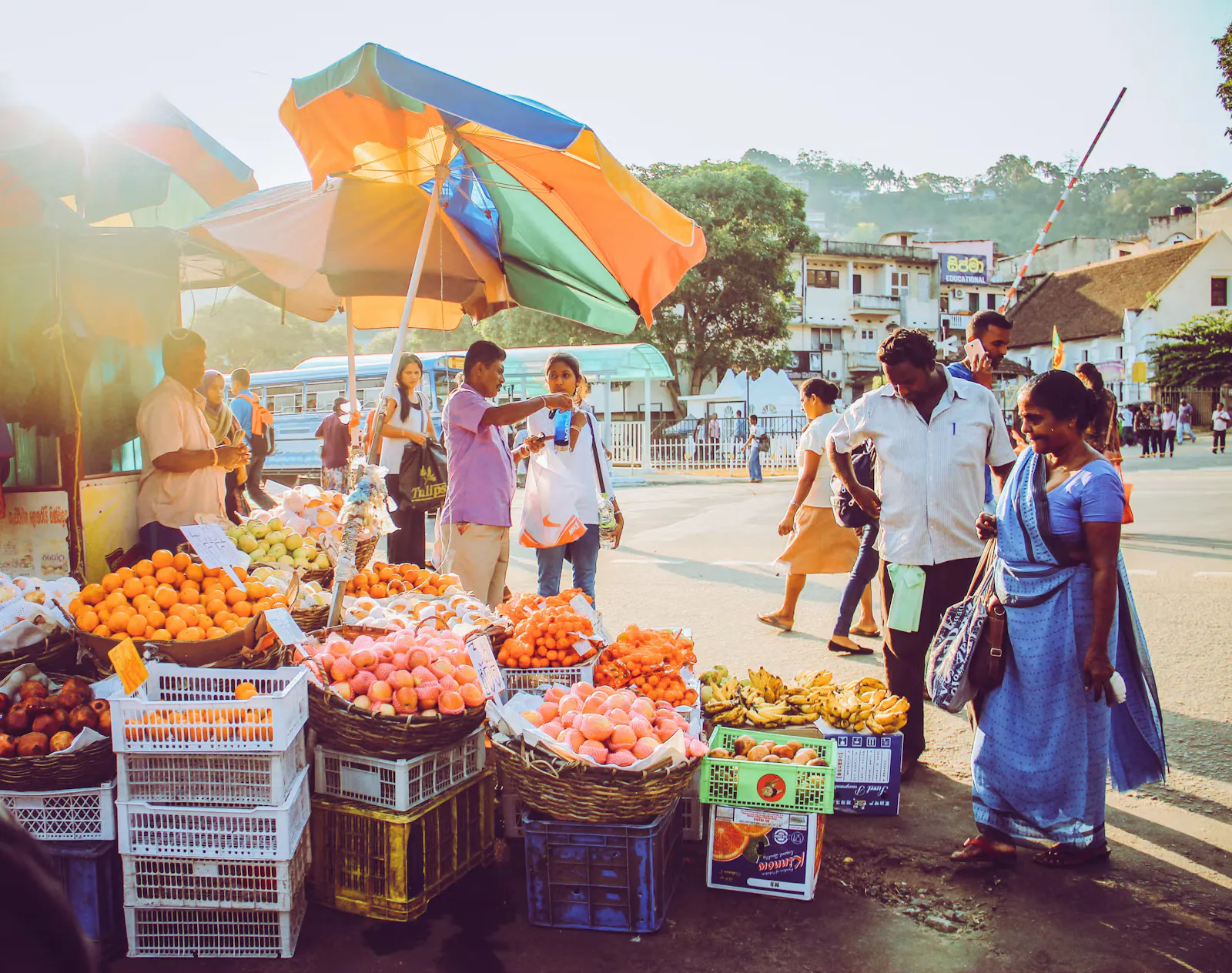
One habit from everyday life: keep small notes. Paying for a king coconut with a Rs. 5,000 note can leave a roadside stall without change, and tuk tuk drivers often can't break big notes either.
What is the best currency to take to Sri Lanka?
Take the major currency you already hold, such as euros, British pounds or US dollars, and change it into the Sri Lanka currency there. The Central Bank of Sri Lanka publishes daily indicative rates for the US dollar, pound, euro, yen, yuan and Australian dollar, so banks exchange these every day. Changing your money into dollars first only adds a second fee.
The Central Bank also publishes average buying and selling rates for telegraphic transfers in nine designated foreign currencies, collected from licensed banks at 9.30 am each day. Those are a good yardstick: if an exchange offer is far away from them, walk on.
Where should you change it? At a licensed bank or an authorised money changer, then count the notes at the counter and keep the receipt. With rates around 370 rupees per euro, a missing Rs. 1,000 note is easy to overlook later.
Paying by card or at an ATM? You'll often be offered a charge in your home currency instead of rupees. That's dynamic currency conversion (DCC). Visa says merchants and ATMs "should give you a choice to accept or decline currency conversion and must not choose on your behalf", and that declining "will not affect your ability to make purchases or withdraw cash internationally". Choose LKR every time. Swiss classmates will find a detailed German guide to ATMs and cards on our sister site: withdrawing money abroad during a placement, written for students in Switzerland.
Secure Information Material
Request all the important info for free, no obligation.
Plan for both. Cash in the Sri Lanka currency covers the small costs of a placement day, such as market fruit, tuk tuks, buses and tips, while a card is handy for bigger bills and for topping up cash at a bank ATM. Carry only the money you need for the day and keep a second card at your accommodation.
How much daily cash you need depends on what your booking already covers. Our Sri Lanka destination page describes the shared travel4med villa with a pool, three meals a day, laundry service, air conditioning and WiFi. So in your hospital weeks you mostly pay for transport, snacks, a SIM card and weekends. Check exactly what your own booking includes.
Two habits help. Withdraw during the day at an ATM inside or next to a bank. And tell your bank you'll be in Sri Lanka, so your first payment in rupees doesn't get the card blocked.
How much cash can you bring into Sri Lanka?
You can bring any amount of foreign money, but you must declare it to Sri Lanka Customs on arrival if the total exceeds USD 15,000 or its equivalent (about LKR 4.99 million). On departure, foreign notes above USD 10,000 must be declared. Sri Lankan rupee cash is limited to LKR 20,000 in or out, about 54 euros.
These rules come from the Department of Foreign Exchange of the Central Bank, in a gazette of 3 February 2021 (No. 2213/39) under the Foreign Exchange Act, No. 12 of 2017. Sri Lanka Customs repeats the USD 15,000 inward and USD 10,000 outward thresholds on its passenger services page. The gazette adds that you may have to show where the money came from.
What does this mean in practice? Don't buy a stack of rupees at home. The LKR 20,000 limit is small, so change only a little, if any, before you fly, and get the rest in Sri Lanka. A placement budget is also far below the declaration thresholds. Rules can change, so check the current version with Sri Lanka Customs or the Sri Lankan embassy in your country before you travel. Entry documents are a separate topic: see our guide to visa requirements for Sri Lanka and Nepal.
Plan your Sri Lanka currency in six steps
Sorting out the Sri Lanka currency takes one evening if you go through it in this order. It works for a four week elective as well as a twelve week nursing placement.
Note the rate: Look up today's LKR rate for your own currency on the Central Bank of Sri Lanka site and write down the quick rule: LKR 1,000 is about 2.70 euros.
Check your cards: Ask your bank what card payments and withdrawals in rupees cost, and pack two cards from two different banks.
Bring your own major currency: Pack a small reserve of euros, pounds or dollars. Don't change it into a third currency first.
Stay under the rupee limit: If you buy rupees at home, keep it below LKR 20,000.
Withdraw or exchange in Sri Lanka: Use a bank ATM during the day or a licensed bank counter, and always choose to be charged in LKR.
Split your money: Carry the cash for the day, and lock the rest and your second card away at your accommodation.
Your placement in Sri Lanka with travel4med
Our Sri Lanka placements are in Galle, on the south coast. According to our Sri Lanka destination page, programmes start every Monday, the price starts from 1,499 EUR, and you can work in fields such as surgery, internal medicine, pediatrics, gynecology, orthopedics or anesthesia. Local costs and your own currency come on top.
Planning your placement in Sri Lanka? Book a free consultation and we'll go through dates, specialty, visa and budget with you, so the Sri Lanka currency is one less thing to worry about. Compare all our destinations too. travel4med is part of the futuredoctor group ecosystem, which supports students from application to graduation.
Central Bank of Sri Lanka. Frequently Asked Questions, Currency (issuing authority under the Central Bank of Sri Lanka Act, No. 16 of 2023; notes and coins in circulation; 2010 note series colours; commemorative Rs. 20 coins): cbsl.gov.lk (accessed 31 October 2026).
Central Bank of Sri Lanka. EUR/LKR indicative rate chart (rate of 30 October 2026, one year and three month history): cbsl.gov.lk (accessed 31 October 2026).
Central Bank of Sri Lanka. USD/LKR indicative rate chart (rate of 30 October 2026 and of 30 October 2025): cbsl.gov.lk (accessed 31 October 2026).
Central Bank of Sri Lanka. Exchange rates overview (indicative rates for six currencies, TT buying and selling rates for nine designated currencies at 9.30 am): cbsl.gov.lk (accessed 31 October 2026).
Department of Foreign Exchange, Central Bank of Sri Lanka. Gazette Extraordinary No. 2213/39 of 3 February 2021 under the Foreign Exchange Act, No. 12 of 2017 (limits for carrying foreign currency and Sri Lanka currency): cbsl.gov.lk (accessed 31 October 2026).
Sri Lanka Customs. Passenger Services Directorate (currency declaration above USD 15,000 inward and USD 10,000 outward): customs.gov.lk (accessed 31 October 2026).
Visa. Dynamic currency conversion: visa.com (accessed 31 October 2026).
travel4med. Sri Lanka destination page (Galle, start days, starting price, accommodation features, fields): travel4med.com/destinations/sri-lanka (accessed 31 October 2026).