Case Report From a Medical Elective: How to Publish It
A case report is a short, peer-reviewed article that describes one patient's diagnosis, treatment and outcome, and explains what other clinicians can learn from it. Writing a case report from your medical elective is one of the most realistic ways for a student to get a first publication, as long as you have the patient's consent, a supervisor on board and a clear lesson to share.
Written by Celina Köhsl, medical student and member of the travel4med team. Reviewed by MUDr. Amandeep Grewal, a doctor on the travel4med team whose review scope covers clinical content.
Key Takeaways
Consent comes first. The CARE guidelines say authors have "an ethical duty to obtain informed consent from the patient to publish patient information", and the ICMJE asks for written consent whenever a patient could be identified.
Masked eyes are not enough. The ICMJE states plainly that masking the eye region in patient photos is inadequate protection of anonymity.
Use the CARE checklist. Its 13 items, from title to informed consent, give your case report a structure editors already know.
Case reports count for the US Match. The NRMP's 2026 Charting Outcomes report lists case reports under publications, where the median for matched non-US IMGs was 3.
The supervisor is your co-author, not your helper. Agree on authorship order with the host doctor before you write a word.
Pick the journal carefully. WAME lists warning signs of predatory journals, such as hidden author fees and no named editor.
What is a case report, and why write one on an elective?
A case report is a structured description of a single patient that teaches something new or unusual: a rare disease, an odd presentation of a common one, a side effect, or a lesson in managing care with limited resources. On an elective you see conditions your home hospital rarely treats, so a strong case report often sits right in front of you.
The format is huge in medicine. A PubMed search for the "Case Reports" publication type returns more than 2.5 million records in total, and between 71,000 and 87,000 for each publication year from 2016 to 2025. Editors keep printing them because one well-documented patient can change how the next doctor thinks.
Case reports indexed in PubMed per publication year, 2016 to 2025 (highest year, 2020, highlighted). Source: our own PubMed search for the "Case Reports" publication type, National Library of Medicine, run in October 2026. Recent years can still grow as indexing catches up.
For you, the value is practical. Writing a case report forces you to read around a condition, follow it from admission to outcome and explain your reasoning in public. It also gives you something concrete to talk about in a residency interview, and it fits neatly into the learning objectives for your elective if you plan it before you leave.
Ready for your adventure abroad?
Secure your spot for your internship abroad now.
Do case reports count as publications for residency?
Yes, at least for the US Match. The NRMP defines publications as "peer-reviewed works such as journal articles, book chapters, and online publications as well as scientific monographs and case reports." A case report published in a peer-reviewed journal therefore sits in the same column as a research paper when you register for the Match.
How much does it move the needle? Less than social media suggests. In the NRMP's 2026 Charting Outcomes report for non-US citizen IMGs (published 28 July 2026, 8,943 applicants in the final sample), the median number of publications was 3.0 for the 4,429 who matched to their preferred specialty and 3.0 for the 4,541 who did not. The numbers are self-reported and not verified by the NRMP.
Median number of self-reported publications among non-US citizen IMGs, by preferred specialty and Match status. Source: NRMP, Charting Outcomes: Characteristics of Non-U.S. Citizen IMGs Who Matched to Their Preferred Specialty, 2026 Main Residency Match, Table 9.
Read the chart honestly. In Internal Medicine, Psychiatry and Neurology the matched group had a higher median. In Pediatrics the unmatched group did, and in Family Medicine there was no gap at all. A case report will not rescue a weak Step 2 CK score. What it does is show interest, follow-through and the ability to write clinically, and it gives your ERAS letters of recommendation something concrete to mention if your elective supervisor writes one.
Which elective patients make a good case report?
A good case report needs a patient whose story teaches something: an unusual presentation, a rare diagnosis, an unexpected complication or treatment effect, or a clever way of managing care with limited tests. "Interesting to me" is not enough. Ask yourself what a doctor reading it in another country would do differently afterwards.
On a placement in Sri Lanka, Nepal, Bali or Zanzibar you may meet diseases that are textbook rarities at home. That is exactly why you should be careful. A condition that is rare for you can be common for your host team, and they will know whether it has been published many times before. Search PubMed together before you start writing.
Three filters help:
Is there a clear lesson? If you cannot write the lesson in one sentence, the case is not ready.
Is the record complete? You need history, findings, test results, treatment and at least some follow-up. Patients who are transferred or discharged early often leave gaps.
Is your role real? You should have seen the patient yourself. Writing up a case you only heard about at handover rarely works.
How do you get consent from a patient abroad?
You get consent by showing the patient, or a legally authorised relative, what will be published, in a language they understand, and getting their written agreement before you submit. The CARE authors call this "an ethical duty", and the ICMJE adds that informed consent "requires that an identifiable patient be shown the manuscript to be published."
Abroad, that takes planning. Your patient may not read English. Ask your supervisor to help you explain the case report in the local language, ideally with a hospital interpreter, and use the target journal's own consent form where one exists. Do it while the patient is still on the ward. Tracking someone down after you have flown home is often impossible.
Anonymity is harder than students think. The ICMJE says names, initials and hospital numbers should not be published unless essential and consented, and that "masking the eye region in photographs of patients is inadequate protection of anonymity." In a small town, an age, a job and an admission date can be enough for neighbours to recognise someone. Leave out every detail the lesson does not need.
Never photograph a patient on your own phone without explicit permission and the hospital's rules in mind. If you study at a German university, travel4med.de has a detailed guide on confidentiality during a placement abroad (in German), including photos and social media.
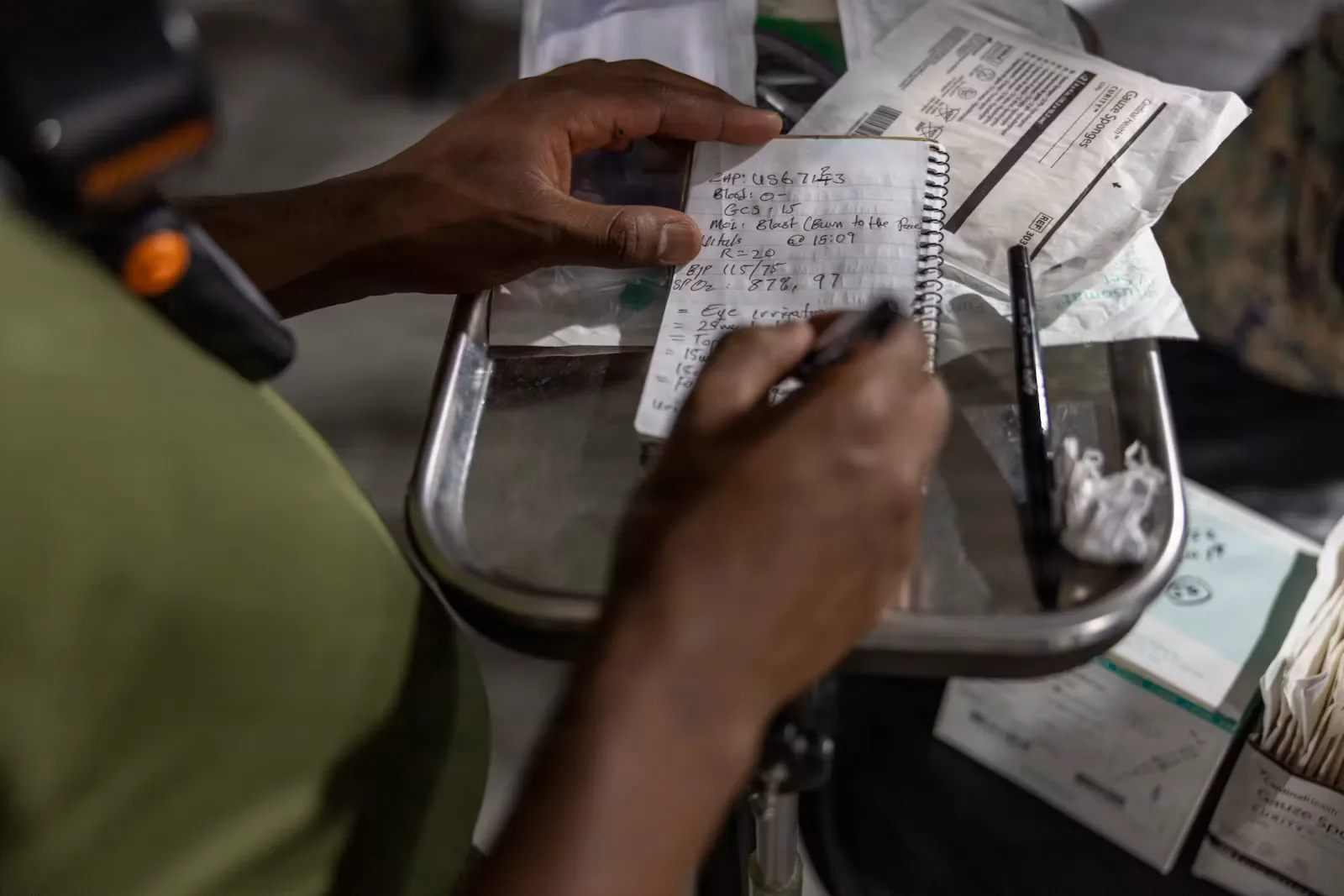
Write down findings, dates and test results as they happen. A case report built from memory weeks later is full of gaps.
How do you write a case report step by step?
You write a case report by securing consent and supervisor support first, collecting the data on the ward, checking the literature, drafting the text in the CARE order and getting every author to approve the final version. Plan on several weeks of work after the elective, not a weekend.
Talk to your supervisor in week one or two. Ask whether a case report is welcome, who will be senior author and whether the hospital needs any internal approval. Some institutions want the head of department or an ethics committee to sign off, so ask rather than assume.
Get written consent while the patient is on the ward. Use the journal's form if you already know the target journal, otherwise a form your supervisor approves.
Collect the data as you go. Keep a dated timeline of symptoms, findings, test results, treatment and follow-up. Store it without names and follow the host hospital's data rules.
Search the literature. Check PubMed for similar cases so you can say honestly what is new.
Draft in the CARE order. Use the 13 items in the table below as headings in your first draft.
Write the lesson last. Once the case is down on paper, sharpen the one or two take-home messages for the discussion and abstract.
Agree authorship before submission. The ICMJE criteria require each author to contribute to the work, to draft or critically revise it, to approve the final version and to be accountable for it.
Choose the journal and submit. Follow its author instructions exactly and attach the CARE checklist if the journal asks for it.
Secure Information Material
Request all the important info for free, no obligation.
What goes into a case report under the CARE guidelines?
The CARE guidelines are a 13-item checklist for case reports, agreed by an international group in 2012 and published in 2013. They are listed on the EQUATOR Network, and many journals expect them. Use them as your outline and your case report will already look the way editors want it.
CARE item
What to write from your elective
1. Title
The words "case report" plus the main point of the case
2. Keywords
Two to five key terms
3. Abstract
What is new, the case in brief, the main lesson
4. Introduction
Why this case matters, with a few key references
5. Patient information
Age range, main complaint, relevant history, without identifying detail
6. Clinical findings
The relevant examination results
7. Timeline
Key dates and events, ideally as a table or figure
8. Diagnostic assessment
Tests, reasoning, the challenges you faced
9. Therapeutic intervention
What was given, how, and any changes
10. Follow-up and outcomes
What happened next, side effects, results
11. Discussion
Strengths, limits, the literature and your lessons
12. Patient perspective
The patient's own view, when they are willing to share it
13. Informed consent
Confirmation that consent was obtained
Item 8 deserves extra care on an elective. If a test was not available at the host hospital, say so and explain how the team reached the diagnosis anyway. That is often the most useful part of a case report from a low-resource setting, and it shows respect for the clinicians who worked within those limits. Our guide to an ethical medical elective abroad explains why that framing matters.
For the writing itself, a German-speaking reader will find a clear introduction to structure, abstracts and writer's block in dein-medizinstudium.ch's guide to scientific writing in medical school (in German).
Who should be an author on your case report?
Authorship goes to everyone who meets all four ICMJE criteria: a real contribution to the work, drafting or critical revision, approval of the final version and accountability for its accuracy. In practice, that usually means you as first author and your host supervisor as senior author, plus any doctor who managed the patient and helped write.
Talk about it early and put the agreement in an email. Students sometimes assume the host doctor will be happy with an acknowledgment, while the doctor assumes they will be senior author. Both are reasonable, so settle it before the draft exists. People who helped but do not meet all four criteria, such as an interpreter or a colleague who proofread, go in the acknowledgments with a short description of what they did.
Remember that your host team owns the clinical story as much as you do. A case report written without them, or submitted without their final approval, is a fast way to damage a relationship that future students rely on.
How do you choose a journal and avoid predatory ones?
Choose a peer-reviewed journal indexed in a major database, read recent case reports it has published and check its author fees before you submit. Then run the journal through a predatory-journal check. Students are a favourite target for fake journals that promise fast publication for a fee and offer no real peer review.
The World Association of Medical Editors (WAME) lists red flags, including when "no single individual is identified as any specific journal's editor", when a journal "provides insufficient information or hides information about author fees" and when it "falsely claims one or more of its journals have actual impact factors." WAME adds that "the more red flags that are present, the more hesitant one should be." Ask your supervisor or a librarian at your home university to confirm your choice.
Before you submit, check the journal as carefully as you checked the case.
Planning a case report into your travel4med placement
travel4med organises clinical placements in Sri Lanka, Nepal, Bali and Zanzibar for medical, nursing and physician assistant students, including final-year placements. We can tell you which departments are available, so you can plan learning objectives and a possible case report before you arrive. Whether a case report gets written is decided by you, your host supervisor and the patient, not by us.
If you want the placement to count at home, check with your faculty's elective office and, where it applies, your national medical council, as our guide to medical elective approval explains. After the placement, the case can feed straight into your medical elective report and, for US applicants, your residency personal statement.
Want a placement where you see cases worth writing up? Browse our destinations or book a free consultation and tell us you are planning a case report. travel4med is part of the futuredoctor group ecosystem, which supports medical students from application to qualification.
Gagnier, J.J., Kienle, G., Altman, D.G., Moher, D., Sox, H., Riley, D. and the CARE Group (2013). The CARE guidelines: consensus-based clinical case report guideline development. Journal of Medical Case Reports 7, 223. Via PubMed Central: pmc.ncbi.nlm.nih.gov (accessed 6 October 2026).
CARE Case Report Guidelines. CARE checklist (2013): care-statement.org (accessed 6 October 2026).
EQUATOR Network. CARE reporting guideline entry: equator-network.org (accessed 6 October 2026).
International Committee of Medical Journal Editors. Protection of Research Participants: icmje.org (accessed 6 October 2026).
International Committee of Medical Journal Editors. Defining the Role of Authors and Contributors: icmje.org (accessed 6 October 2026).
National Resident Matching Program (28 July 2026). Charting Outcomes: Characteristics of Non-U.S. Citizen IMGs Who Matched to Their Preferred Specialty, 2026 Main Residency Match: nrmp.org (accessed 6 October 2026).
National Library of Medicine. PubMed search for the Case Reports publication type, publication year 2025: pubmed.ncbi.nlm.nih.gov (counts for 2016 to 2025 retrieved October 2026).
Laine, C. and Winker, M.A., World Association of Medical Editors. Identifying Predatory or Pseudo-Journals: wame.org (accessed 6 October 2026).